
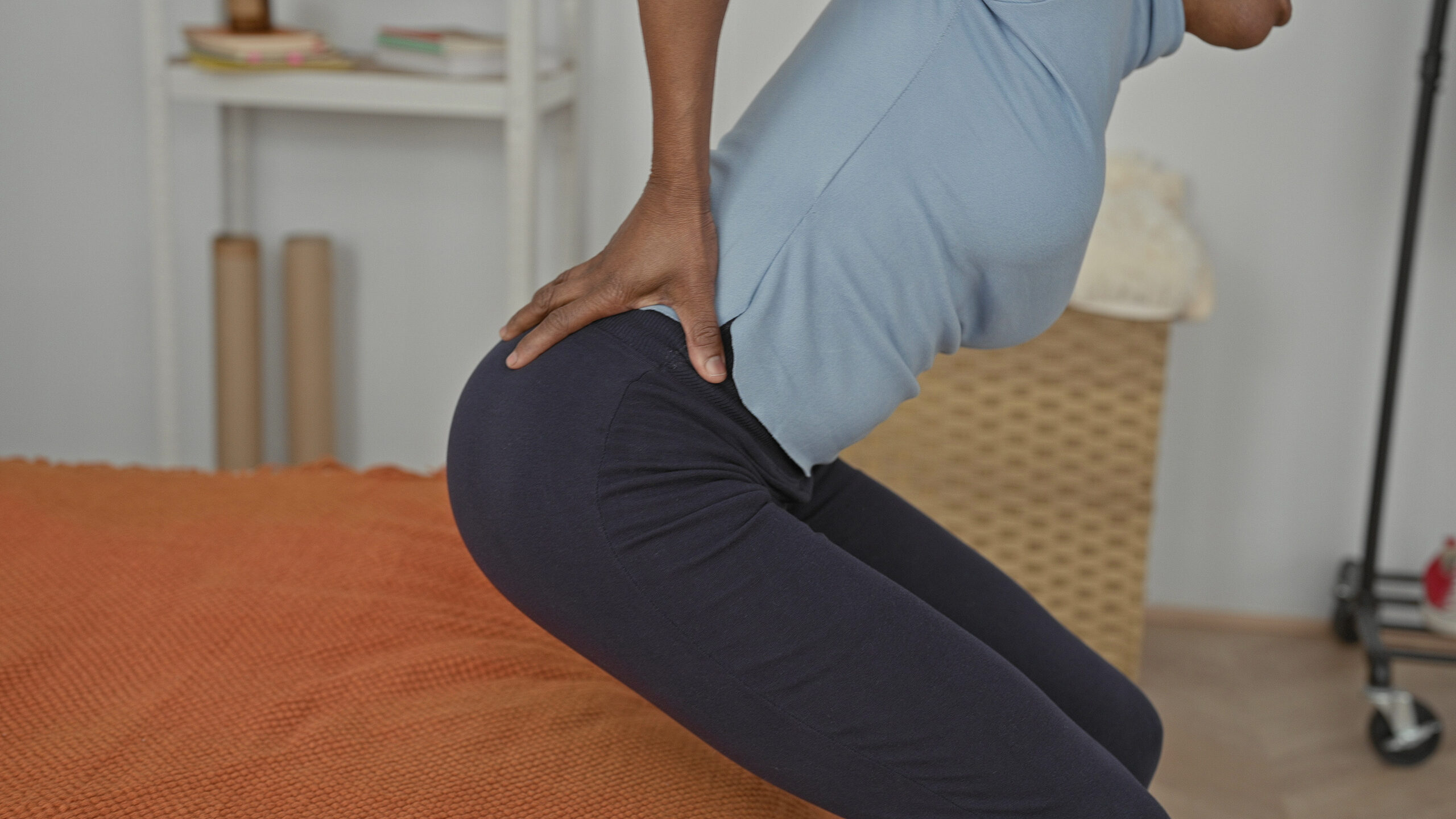
Why Does the Outside of My Hip Hurt When I Sleep on It?
- Pain on the outside of your hip when you sleep on it is commonly associated with greater trochanteric pain syndrome (GTPS), often involving irritation of the gluteal tendons around the bony outside of the hip.
- Side sleeping can make the pain worse because it places sustained pressure on already sensitive tissues around the hip.
- Changing your sleep position may calm symptoms temporarily, but recurring pain often needs a closer look at tendon load, hip strength, movement patterns, and surrounding muscle tension.
What Usually Causes Outer Hip Pain When You Sleep on Your Side?
One of the most common causes of pain on the outside of the hip is greater trochanteric pain syndrome, or GTPS. The pain develops around the greater trochanter, which is the bony point you can feel along the outside of your upper thigh.
Although this problem was traditionally called trochanteric bursitis, research shows that the gluteus medius and gluteus minimus tendons are frequently involved, sometimes with irritation of the nearby bursa. A review of GTPS estimates that it accounts for 10% to 20% of hip pain seen in primary care and occurs two to four times more frequently in women.
In one large community study, unilateral GTPS affected about 15% of women and 6.6% of men.
Typical symptoms include tenderness over the outside of the hip, aching into the outer thigh, and pain during walking, climbing the stairs, standing on a single leg, or sleeping on the affected side.
Not all hip pain comes from the same tissues, though. If your discomfort is more toward the front of the hip or groin, our guide to hip and groin pain covers several other patterns worth considering.
Why Does Lying on Your Side Make Hip Pain Worse?
When you sleep directly on the painful side, your body weight compresses the sensitive tissues on the outside of the hip for an extended period. If the gluteal tendons or bursa are already irritated, that pressure can make an ache that was manageable during the day much more noticeable at night.
Interestingly, the opposite side can sometimes hurt too. If you lie on your pain-free side and allow the top knee to fall inward toward the mattress, the painful hip moves into adduction. That position can increase compression around the gluteal tendons.
So, if your hip mainly hurts in bed, the sleeping position itself may be exposing an area that is already sensitive rather than being the original cause of the problem.
Is Outer Hip Pain Really Bursitis?
Sometimes, but not always.
The term trochanteric bursitis is still commonly used for pain people feel on the outside of their hip. The trochanteric bursae are small structures filled with fluid that help reduce friction around the hip, and they can become irritated.
However, imaging and clinical research have shown that many people with lateral hip pain also have gluteal tendon changes. This is why clinicians increasingly use greater trochanteric pain syndrome as the broader term rather than assuming every case is simply inflamed bursae.
That distinction matters because resting until the inflammation settles may not address why the area keeps getting overloaded. If tendon capacity, hip strength, or movement habits are contributing, those factors may also need attention.
What Else Can Cause Pain on the Outside of Your Hip at Night?
GTPS is common, but several other problems can produce pain in or around the same area.
- Hip osteoarthritis can cause stiffness, reduced movement, and night pain, although discomfort is often deeper in the groin or front of the hip.
- Lower back or nerve-related pain can travel into the buttock and outer hip. Burning, tingling, numbness, or pain extending farther down the leg makes nerve involvement more important to consider.
- Muscle overload around the glutes, hip flexors, and surrounding tissues can add tenderness and change how the hip moves.
- A sudden spike in running, training, or other activity can irritate tissues that are not prepared for the new workload.
- Gluteal tendon tears or other hip conditions may need to be ruled out when pain is persistent or accompanied by noticeable weakness.
What Can You Do Tonight to Reduce Hip Pain While Sleeping?
If lying on your hip is making the pain worse, reducing compression can give the irritated area a break.
Try avoiding the painful side for a while. If you sleep on the opposite side, place a pillow between your knees so your top leg stays supported rather than dropping across your body. Sleeping on your back with a pillow underneath your knees can also be more comfortable for some people.
During the day, try not to spend long periods standing with your weight pushed into one hip or sitting with your legs crossed. These positions can also increase compression around the lateral hip.
Gentle movement is often helpful, but avoid repeatedly forcing the outer hip into stretches that reproduce the same pain. With irritated gluteal tendons, more stretching is not automatically better.
If these adjustments help temporarily but the pain returns as soon as you roll onto your side again, it may be time to look beyond your sleeping position.
How Do You Treat Outer Hip Pain That Keeps Coming Back?
Treatment depends on what is causing the pain, but recurring lateral hip pain usually responds better when you address both how the tissues are being loaded and how the hip is functioning.
Load Management and Strengthening
For gluteal tendinopathy, education and progressive exercise have some of the strongest evidence.
A randomized trial involving 204 adults compared education plus exercise, a corticosteroid injection, and a wait-and-see approach. At eight weeks, education and exercise produced better global improvement than either injection or waiting. At 52 weeks, 51 of 65 participants in the education and exercise group reported successful improvement compared with 36 of 63 in the injection group.
A more recent 2025 systematic review of gluteal tendinopathy treatments found moderate-strength evidence supporting education and exercise as a core approach for improving pain and function.
Hands-On Treatment
Hands-on care can complement that plan when surrounding muscle tension, tenderness, or movement restrictions are making the hip harder to use comfortably.
At FixingPain Clinic, massage therapy may include different techniques depending on what the assessment finds. More targeted options such as sports massage therapy or Active Release Techniques are also incorporated when appropriate.
However, massage doesn’t rebuild an irritated tendon on its own. The goal is to address surrounding soft tissue discomfort and movement limitations while the broader plan deals with load, strength, and the reason the hip keeps getting irritated.
Shockwave Therapy
Shockwave therapy is another option sometimes used for persistent GTPS and gluteal tendinopathy.
A 2024 meta-analysis of eight randomized trials and 754 participants found that extracorporeal shockwave therapy produced lower pain scores than comparison treatments at 2-4 months. However, seven of the eight trials had a high risk of bias, so the results should be interpreted cautiously.
FixingPain Clinic offers SoftWave Therapy as one option within a personalized treatment plan. The research above evaluates extracorporeal shockwave therapy broadly rather than the SoftWave device specifically, so it should not be treated as evidence that one technology is automatically right for every case.
When Should You Get Outer Hip Pain Checked?
Get the pain evaluated if it regularly wakes you at night, lasts for several weeks, keeps getting worse, or begins interfering with walking, climbing stairs, exercise, or everyday movement.
You should also seek medical evaluation sooner if the pain follows a significant fall or injury, you cannot comfortably bear weight, you develop marked weakness, or you experience numbness, tingling, or pain traveling well down the leg.
Persistent outer hip pain can resemble problems coming from the hip joint or lower back, so figuring out what is actually driving the symptoms is more useful than assuming every painful hip is bursitis.
Stop Letting Outer Hip Pain Keep You Up at Night
Changing sleeping positions can reduce pressure, but if the same hip keeps hurting every night, it is worth figuring out why the area is so sensitive in the first place.
At FixingPain Clinic in Pleasanton, we look at how your hip moves, where the tension is coming from, and what may be repeatedly aggravating the area. From there, treatment can be tailored to what your body actually needs.